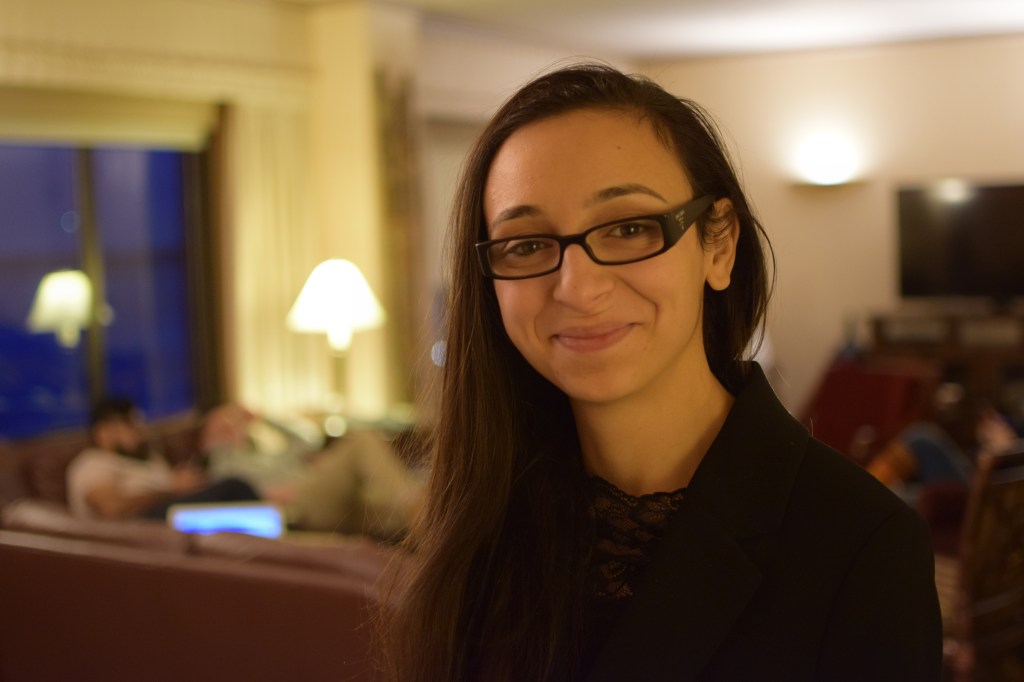
I am an Astroparticle Physicist
Lina Necib is an Associate Professor of Physics at MIT, where she is affiliated with the MIT Kavli Institute for Astrophysics and Space Research (MKI) and the Institute for Artificial Intelligence and Fundamental Interactions (IAIFI). Her research focuses on the distribution of dark matter in galaxies, using stellar kinematics, cosmological simulations, and machine learning to reconstruct the dynamical history of the Milky Way and infer the fundamental properties of dark matter from it.
Necib earned a B.A. in Physics and Mathematics from Boston University in 2012 and a PhD in Theoretical Particle Physics from MIT in 2017, advised by Prof. Jesse Thaler. She held postdoctoral positions as a Sherman Fairchild Fellow at Caltech (2017–2020), a University of California President’s Fellow at UC Irvine (2020), and a Fellow at the Carnegie Observatories (2020–2021), before joining the MIT faculty in 2021. Born and raised in Tunisia, she moved to the US in 2008.
Her work has been recognized with a Sloan Fellowship, an NSF CAREER Award, and the American Physical Society’s George E. Valley Jr. Prize. She leads a research group of postdocs and graduate students at the intersection of astrophysics, particle physics, and machine learning.
Research
Galactic Dynamics
Using Gaia, I model the kinematics of accreted stars, some of which originate from particular merger events such as the Gaia Sausage/Enceladus. I also discovered a new structure, called Nyx, after the Greek goddess of the night. My group now works to reconstruct the Milky Way’s full merger history, and to map the dark matter distribution through stellar streams, escape velocity, and rotation curves.
Telescopes & Surveys
I analyze data from telescopes and surveys to understand stellar kinematics and what they reveal about dark matter — including Gaia, the Sloan Digital Sky Survey, high-resolution spectroscopy from Magellan and Keck, and, more recently, Euclid.
Simulations
I use hydrodynamic simulations, including FIRE and IllustrisTNG, to connect dark matter to observable signatures. This includes building synthetic Gaia surveys from simulated galaxies, and testing how alternative dark matter models — such as self-interacting and dissipative dark matter — alter the structure of galaxies.
Machine Learning
I develop machine learning methods to extract dark matter properties from noisy, incomplete astronomical data — graph neural networks to infer dark matter density profiles in dwarf galaxies, unsupervised learning to find stellar streams across the full sky, and physics-informed neural networks to reconstruct galactic gravitational potentials.

